
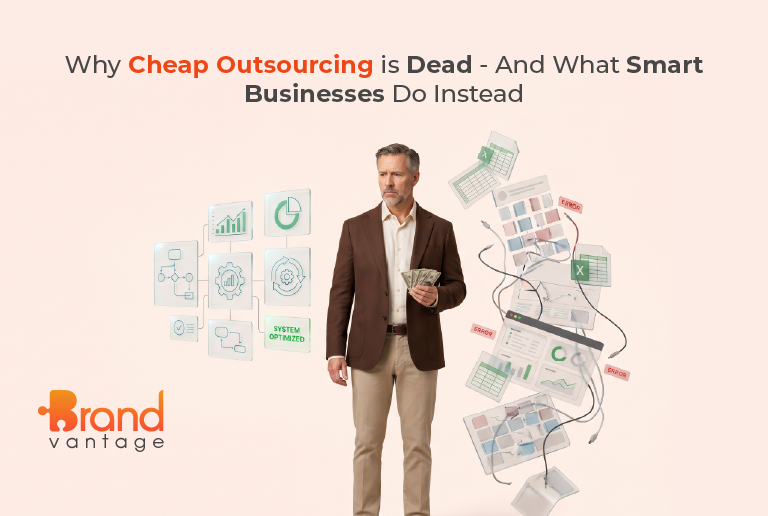
For a decade, cheap outsourcing was the go-to answer for every growth-stage business trying to do more with less. Low hourly rates. Quick hires. Offshore teams standing by. The pitch was simple: pay less, get more done, scale faster.
It worked. Until it didn’t.
The businesses that bought into cheap outsourcing didn’t fail because they were careless. They failed because the model itself was never built for what they actually needed. And now, as operational complexity grows and customer expectations rise, the cost of getting outsourcing wrong has become too high to absorb.
Cheap outsourcing isn’t dead because it got more expensive. It’s dead because it was never actually cheap.
The Real Price of Low-Cost Outsourcing
Every business that has chased the lowest hourly rate knows the pattern.
You bring in a team. The onboarding takes longer than expected. Output is inconsistent. You spend time explaining the same things to different people every few weeks because the team keeps rotating. Quality slips on the days you’re not watching. You start managing the team more closely, which means the workload you tried to outsource has quietly moved back onto your plate.
Now run the actual numbers. The cost of your time spent managing. The cost of errors caught late. The cost of customers who had a substandard experience and didn’t come back. The cost of rebuilding processes every time someone leaves.
The invoice said one thing. The total cost said something else entirely.
Cheap outsourcing always had a second invoice. It just arrived later.
Why the Model Broke Down
Cheap outsourcing was built on one assumption: that labour was the variable, and everything else would stay constant.
It was never true. Labour without process produces inconsistent output. Teams without documentation create operational fragility. Providers without accountability create the illusion of delegation while leaving the actual ownership with the client.
The businesses scaling in 2025 and beyond understand something that the old model missed entirely: the people were never the problem. The system was.
Put good people inside a broken system and you get broken outcomes. Every time. The solution was never to find cheaper people. The solution was to build a better system and staff it properly.
That is the shift happening right now across every industry. Operations that used to be treated as a cost line are being treated as a competitive asset. Businesses that get their operations right scale faster, retain customers longer, and run leaner than those that don’t. The ones that are still shopping for the lowest rate are still paying the second invoice.
What “Good” Outsourcing Actually Looks Like
The move away from cheap outsourcing doesn’t mean spending more for the sake of it. It means demanding more from the model and choosing partners who can actually deliver it.
The businesses getting this right are prioritising four things.
Documented systems over undocumented talent. The best team in the world becomes a liability the moment they leave if nobody wrote down how they did the work. Systems that are documented, standardised, and independent of any individual are what actually scale.
Defined accountability over vague deliverables. The shift from “complete these tasks” to “own these outcomes” changes everything. Managed operations with agreed KPIs, structured reporting, and genuine performance accountability are what drive measurable results.
Consistency over cost per hour. A slightly higher cost per hour that produces consistent, measurable output at scale is less expensive than a lower rate that produces variable quality you have to monitor, correct, and occasionally redo.
Visibility over reports. Monthly summaries that say things are broadly on track are not visible. Real-time dashboards, agreed metrics, and a partner that flags problems before you notice them, that is what operational visibility actually means.
These aren’t premium features. They are the baseline for outsourcing that actually works.
The Businesses That Are Winning Operationally
Across energy and utility, e-commerce, IT, healthcare, accounting, and technology, the pattern is consistent. The businesses growing fastest are not the ones with the cheapest operational setup. They are the ones with the most structured one.
Their backend runs without constant input from leadership. Their teams operate to documented standards that survive staff changes. Their reporting is proactive, not reactive. Their operations scale when their revenue scales rather than becoming the bottleneck that holds the growth back.
This is not a coincidence. It is the outcome of treating operations as a strategic function rather than a cost to be minimised.
Why Brand Vantage Is Built Differently
Brand Vantage builds and runs the operational engine behind growing US businesses. Real systems. Stable teams. Outcomes that are owned, not reported.
Every engagement starts with process design and documentation before anyone starts work. Every function we manage runs to defined KPIs and a structured reporting cadence. Every team we build is trained on your systems, aligned to your workflows, and accountable for your outcomes.
We are not the cheapest option. We are the one that doesn’t cost you twice.
If you are still absorbing the cost of outsourcing that never fully delivered, the strategy call is worth having. We will map what is broken, show you what we would build, and give you a clear picture of what it would cost to do it properly.
Brand Vantage provides Operations as a Service for growth-stage businesses across the United States. We design, build, and manage the operational backend, so growth does not expose your gaps.